Is Warm Water Good for Surf Fishing? The Surprising Truth
It’s one of the most common questions in surf fishing, and the answer is almost never what people expect: is warm water good for surf fishing?
The short answer is that it depends entirely on where you fish and what species you’re targeting. The longer answer is that the best surf fishing almost never happens when water temps are at an extreme in either direction. What every surf angler really wants – whether they’re fishing San Diego, Oregon, or Baja – is a normal year. Not too warm, not too cold. Just the temperature range that the ecosystem you’re fishing has evolved around. The summer of 2026 taught me this lesson in the most direct way possible, and the data from the Pacific Coast tells the same story in every direction.
Warm Water and Surf Fishing: The Simple Version
Water temperature is one of the most important environmental variables in surf fishing. It determines which species are present, where they feed, when they feed, and how aggressively they do it. Different species have evolved to thrive in specific temperature ranges – and when temps move outside those ranges, fish (and other animals and organisms in the ecosystem) either stop feeding, move somewhere else, or both.
This means warm water and surf fishing is not a simple good or bad equation. Warm water is excellent for surf fishing if you’re fishing Baja California and targeting roosterfish, which prefer water temperatures around 80°F and actively hunt baitfish in the surf zone on sandy beaches. Warm water can be terrible for surf fishing as we saw in San Diego during an El Niño year (2026) and the temperatures pushed above 74-75°F, sending corbina and spotfin croaker north toward cooler water and disrupting the food chain that keeps them in the surf zone.
The water temperature that makes for great surf fishing is the temperature that’s normal for your specific location. Everything beyond that – in either direction – tends to work against you.
The Pacific Coast Temperature Gradient: A Case Study in How This Works
The Pacific Coast of North America runs from the cold, nutrient-rich waters of the Pacific Northwest down through California and into the warm tropical waters of Mexico. Each stretch of coastline has its own average temperature range, its own ecosystem, and its own surf fishing species. Looking at how this plays out from north to south is one of the clearest illustrations of the warm water and surf fishing relationship available anywhere in the world.
Oregon and Washington: 50-58°F
The surf fishing in the Pacific Northwest is built entirely around surfperch – redtail surfperch in particular, which thrive in water temperatures of 52-65°F. Oregon and Washington have excellent year-round surf fishing for surfperch, with peak season running from late winter through summer as spawning fish move into the shallows. The cold water that would completely shut down a San Diego corbina bite is exactly the temperature these fish prefer.
You will not find corbina, spotfin croaker, or yellowfin croaker in Oregon surf. The water is too cold for those species. But the redtail surfperch fishing can be exceptional – you just have to know that what you’re targeting has evolved for that cold water environment, not in spite of it.
Northern California: 51-58°F year-round
Water temperatures at Trinidad and Crescent City barely climb above 58°F even in August. The surf fishing here remains anchored to cold-water species – surfperch, rockfish, lingcod accessible from jetties. Again, excellent fishing for what belongs there, nothing like what you’d find in San Diego.
Santa Barbara: 56-65°F
Santa Barbara sits roughly 220 miles north of San Diego and its water temperatures run consistently 5-7°F cooler throughout the year. Summer averages in Santa Barbara peak around 63-65°F where San Diego is running 68-72°F in a normal year. That difference sounds small but it matters enormously for the species that depend on it.
Santa Barbara has a solid surfperch fishery and reasonable halibut fishing. What it doesn’t have is a reliable corbina and spotfin croaker fishery the way San Diego does. Those species are warm water fish calibrated to the temperatures that San Diego normally produces. At 63°F Santa Barbara is simply too cool for them to thrive consistently. Move 220 miles south and the same species become the primary target of the summer surf fishery. The corbina and spotfin fishery (while present in Santa Barbara, is significantly less reliable and consistent than in San Diego, as it represents the cooler northern edge of their range – present during warm water events but not the reliable summer staple it is further south.
San Diego: 64-72°F (normal summer range)
This is the sweet spot for the species that define SoCal surf fishing. Corbina bite well between 64-72°F. Spotfin croaker, yellowfin croaker, and surfperch all produce within this range. The surf zone ecosystem – plankton, sand crabs, baitfish, the food chain that brings these species into the shallows – functions normally and reliably in this temperature window.
Below 64°F the corbina bite slows significantly. Above 72°F and you start to see the same species pushing north toward cooler water or simply becoming less active and harder to find in the places you’d normally expect them. This is exactly the pattern you see in a normal healthy year – as we get into late fall and winter, the temp drops below what corbina and croaker prefer and they become less frequently caught while it’s more inline with what larger surfperch and other species prefer and you see a rotation if the fishery until the next warm season.
Check out the dropdowns below to see the exact gear and tackle I use to catch all kinds of fish in the So Cal surf.
Light Tackle Gear
- Rod: Okuma Celilo (8’6″ MA) or the Okuma SST (8’6″ MA)
- Reel: Penn Battle 3000 or 4000 series
- Mainline: 15-pound monofilament
- For Bait: Carolina Rig:
- Leader Line: 15-pound fluorocarbon
- Swivels: 15-19mm barrel swivels
- Hooks: size #2 or #4 owner mosquito hooks
- Weights: 1-oz egg weight
- Beads: 8mm fishing beads
Swim Bait Gear
- Rod: Okuma SST-S-902HA – 1/2-2oz | 10-30lb | 9ft | H | MF
- Reel: Penn Spinfisher VI (3500 or 4500)
- Main Line: 30-pound braid
- Leader Line: 30-pound mono
- Lure Options:
Jerk Bait Gear
- Rod: Okuma SST (8’6″ MHA)
- Reel: Penn Battle 3000 or 4000 series
- Main Line:
- Leader Line: 15-pound fluorocarbon
- Lures: Lucky Craft FM 110 and Shimano WM 115 SP
Shark Gear
- Rod: Fiblink Moonsniper (12 or 13 feet)
- Reel: Penn Battle 8000
- Main Line: 50-pound braid
- Topshot: 80-pound nylon coated mono
- Leaders: Shark Leaders
- Weights: 8-ounce pyramid or 6-ounce sputnik
Baja California and Mexico: 75-85°F
Drop south of the border into Baja and the surf fishing world changes completely. The species that dominate the inshore surf zone here – roosterfish, jack crevalle, cubera snapper, sierra mackerel – are warm water predators that prefer temperatures around 80°F. Roosterfish are found exclusively in the Eastern Pacific from Baja south to Peru and actively hunt baitfish right in the surf zone on sandy beaches, sometimes in water just a few feet deep. They can grow over 100 pounds and are one of the most sought-after surf fishing targets in the world.
You will likely never catch a roosterfish in San Diego. The water is too cold for them. They belong in Baja the same way corbina belong in San Diego and redtail surfperch belong in Oregon. Each species is precisely adapted to its own thermal environment.
When Warm Water Becomes a Problem in SoCal: The 2026 Lesson
I wrote about this at length in my full breakdown of the 2026 surf fishing season, but the summary is straightforward: 2026 was a developing El Niño year that pushed San Diego beach water temperatures to 74-75°F through the summer – 5-7°F above the normal range for peak season. The results were the worst light tackle and lure surf fishing season I’ve experienced in 12 years on this coast.
The elevated temps disrupted upwelling, which removed the nutrient base that drives the nearshore food chain. Sand crabs never established reliable beds because of the lack of nutrients and the persistent swell pattern that came with El Niño kept moving sand on and off the beaches. And the fish – corbina, spotfin, yellowfin croaker etc. – appear to have pushed north toward water temperatures more in line with what they’re calibrated to, leaving the San Diego surf zone noticeably quiet through what should have been peak season.
I tracked every guided session through the year. Light tackle fish counts were down roughly 60% compared to 2025. The wide open multi-species sessions that define a normal SoCal summer simply didn’t happen.
For more on what went wrong and why, read: How El Niño Ruined Surf Fishing in 2026
The Upside of Warm Water: When Things Get Interesting
Warm water and surf fishing do have a genuinely exciting relationship when the warmth brings species into range that don’t normally belong there.
During the same El Niño conditions that disrupted the 2026 inshore bite, a local offshore angler I spoke with described some of the best marlin and coastal yellowtail fishing he’d seen in years. The warm water that hurt the surf zone helped the offshore fishery considerably – the same driver producing opposite effects depending on where you were fishing.
This pattern holds true in the surf zone too. During unusually warm water years, species that don’t normally come close enough to shore to be reached from the beach occasionally push into the surf zone.
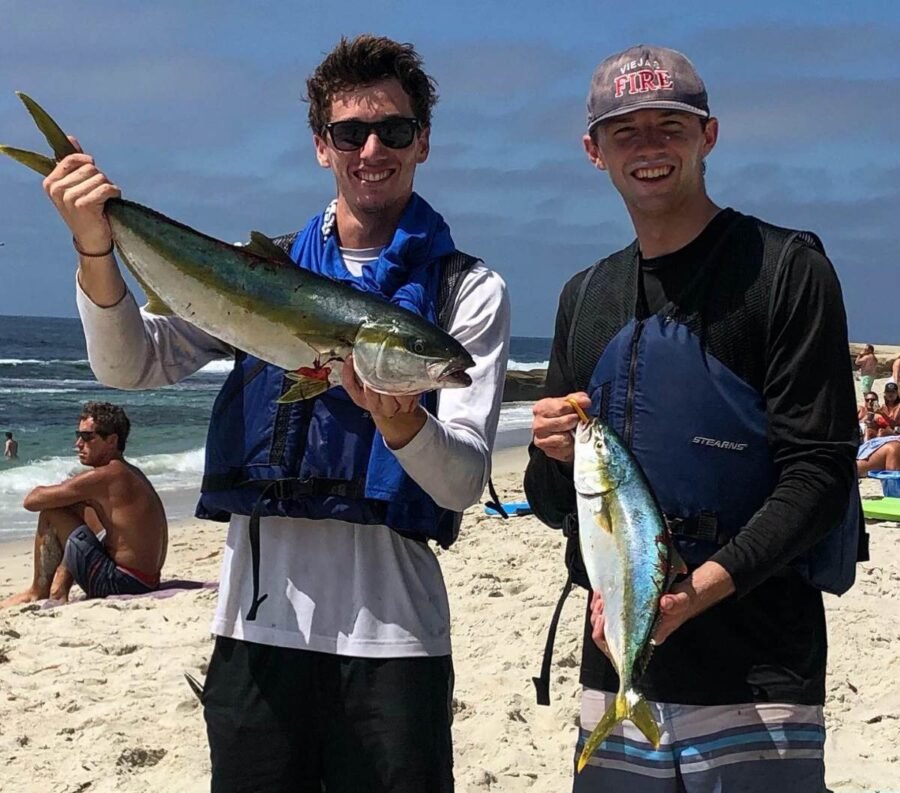
I experienced this firsthand during a warm water summer in 2020. A client on a guided session hooked a fish on a shark rod that fought unlike anything either of us had seen before. It took line with the kind of sustained initial run that a large soupfin shark will produce, but when it finally came to the surface, it wasn’t a shark. It was a 53.5-pound yellowtail – 57 inches full-length – that had apparently pushed into the surf zone chasing bait during an abnormally warm water period. As far as I’m aware it remains the largest yellowtail ever caught from the beach. The full story is worth reading: World Record Yellowtail Caught from Shore
That fish happened because warm water pushed a pelagic species into a place it had no business being. That’s the exciting side of warm water surf fishing – the chance encounters with species that don’t belong in the surf zone but show up anyway when the conditions are right.
The honest qualifier though is this: for every unexpected yellowtail or other exciting species that shows up during a warm water event, you trade weeks of reliable corbina and spotfin action that the elevated temps have suppressed. The novelty is real. The disruption to the regular fishery is more real.
The Answer to “Is Warm Water Good for Surf Fishing?”
The most accurate answer is: warm water is good for surf fishing if it’s the right temperature for where you’re fishing.
80°F water in San Diego is a problem. 80°F water in Baja is where the roosterfish are. 55°F water in Oregon is prime redtail surfperch water. 55°F water in San Diego means the corbina bite is weeks away from turning on.
The temperature that produces great surf fishing is always relative to the ecosystem you’re in. Each stretch of coastline has evolved its own species, its own food chain, and its own seasonal patterns around a specific temperature range. When conditions match that range, the fishing reflects it. When conditions push significantly above or below it – whether from El Niño, La Niña, a late season heat event, or an early cold snap – the fishing suffers.
After 12 years on the San Diego coast and a 2026 season that delivered the clearest possible demonstration of what warm water does to a surf fishery that’s calibrated to something cooler, my honest answer is simple: the best water temperature for surf fishing is whatever’s normal for your home break. Fish long enough and you learn to appreciate a normal year more than any anomaly – warm or cold – that comes along to disrupt it.
For the full breakdown of how El Niño specifically affected surf fishing in 2026, read: How El Niño Ruined Surf Fishing in 2026
Went to Cambria last week and tried the surf. It was crazy, at least 25 different surf perch in 2 hours. I am from Huntington Beach and it has been lousyb here all summer for me.
John
Incredible! Any other species?